A field report from ChangeNOW in Paris: On AI, sustainability, and mission-driven work
I want to get all this out before I properly forget the content and lose the last zings of energy that came from attending the ChangeNow Conference that took place fin-de-siecle March. It’s been over a week, so thankfully I took plenty of notes. But will probably work backward to risk the least.

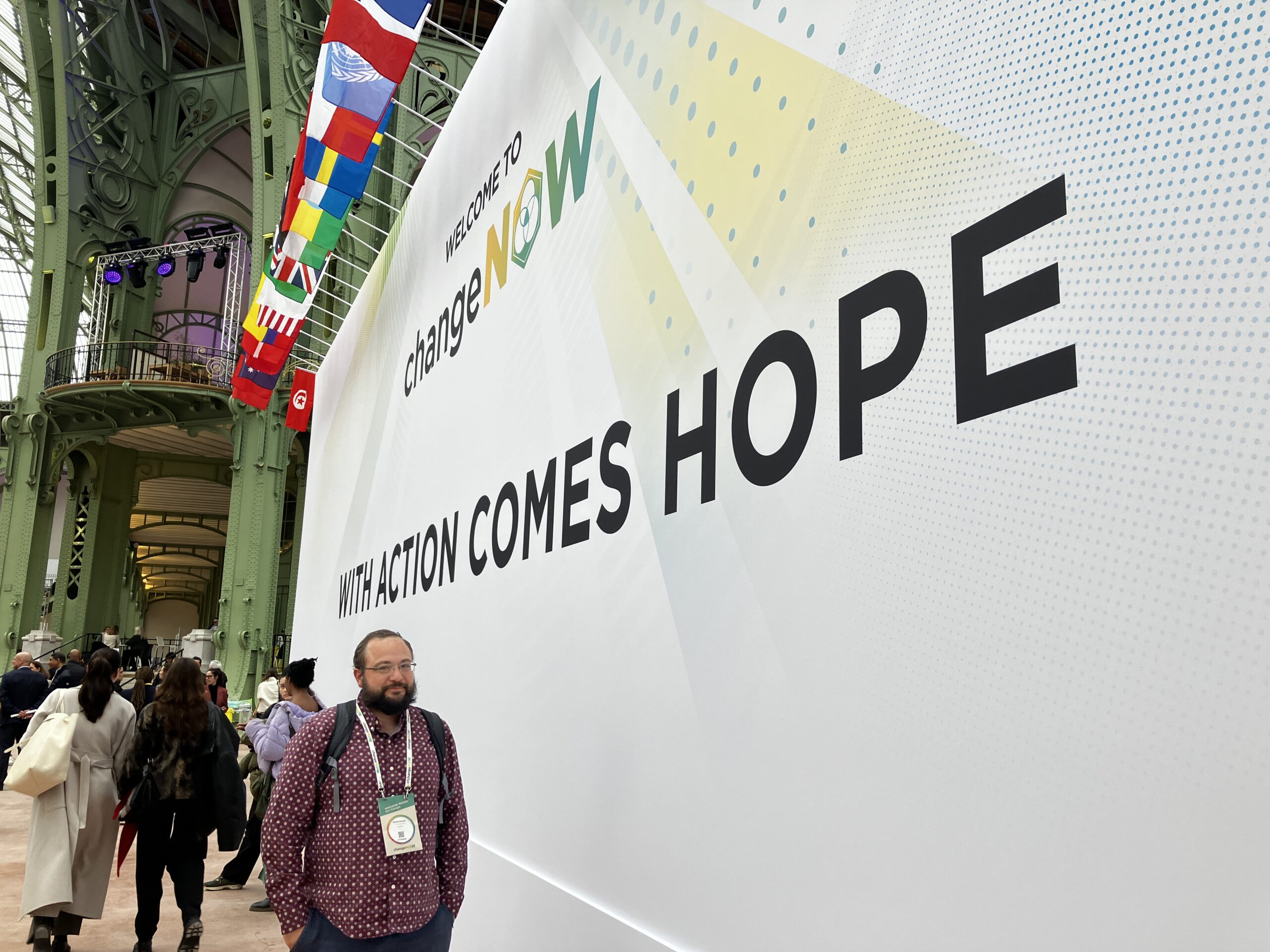
To start, I want to say that the highlight of the two days I attended (would have been 3 but not for a wicked mal-a-la-gorge 😮💨😮💨the day after our lovely arrival and lengthy flânerie in Montmartre) was meeting some changemakers in person. I am sure if I were really brave, it would have been loads more, but we kept puttering around the sections for education and the Netherlands’ own contingent of Haagenaars and Amsterdammers, just fancy enough to fit right into the ornate milieu that is Grand Palais expositions. I was but a lowly Utrechter, nay cosmopolitan American, nay really mundane American. Listen, I speak French fluently and agonized over the wardrobe I brought in my valise for at least 30 minutes, so excuse me if I had already spread myself thin enough.
Let me set my loud insecurities aside for a minute as I speak on these most impressive mademoiselles:
- a nonprofit cofounder of an organization that helps girls in Rwanda build STEM opportunities for themselves. It was wonderful seeing how she’s beginning to integrate AI literacy into this work. And as she flits between Paris and Kigali, it’s good to know they’ve begun direct flights!
- Cecile Rivoiron, someone with many years under her belt in health tech currently hoping to move within the ESG space with innovative collaboration models. Her background in mental health and innovation means that ChangeNow had great potential for her to weave her many skills into a partnership.
- another Dutch transplant like me, is working in a very, well, aligned space to AlignIQ. She came as a part of the Dutch delegation with expertise in training mission-forward companies in AI applications of SAAS/Cloud. I look forward to meeting her again soon in one of the great homes of green innovation and social enterprise, Amsterdam.
Again, working backward.
The last item of my agenda during the actual presentation portion of ChangeNow was to be the closing keynote, but we vamoosed in favor of a rush hour duck-out to divine ourselves towards the Eiffel Tower.

Hope in Action: Reclaiming the Narrative
Instead, I attended something Dan had signed up for that first featured Erin Gruwell, the original Freedom Writer. Could have easily keynoted for the White Savior Summit. I hadn’t known the conference attracted celebrities beyond Matt Damon on video (which we missed because we were busy teaching our Safe, Ethical AI class at our hotel in a banlieu). I feel bad that her appearances invariably begin with the trailer for a movie featuring a two-time Oscar winner, but her presence is quite powerful. Unfortunately, I am not sure how her speech did anything to connect me further to the conference’s vision of a sustainable future.
Worn Out: Fashion’s Waste Problem
This panel on textile waste was eye-opening. I know a little bit about the watchdogging of the labor side of the industry thanks to my sister (who also speaks French! and whose advocacy has actually appeared in Vogue!) I have also stood before bevies of textile and electronic waste as a media intern in Accra, Ghana. It was encouraging to see creatives and owners in the fashion industry speak up for MORE regulation in an industry famous for trying to convince customers that their product is ANYTHING BUT recycled. Julia Faure, founder of Loom, is working on policies that would incentivize industrial upcycling and punish fast fashion methods. Fast fashion, as of now, leads to much more environmental degradation (and maybe even labor malpractice) than say, the AI industry. 30% of what gets manufactured never gets worn. We learned that to reduce your carbon footprint to the global average, purchase only 5 clothing items (of ANY TYPE) per year–this would probably motivate us to get higher quality items, right? I still need to perfect a system for not spilling salad oil on the majority of my shirts, but I resolve to try harder to get these stains out in the future.
Le football peut-il vraiment contribuer à un monde meilleur
The only primarily French presentation I attended…just for “kicks!” I got to listen to folks “pitch” the “goal” of football to be an all-inclusive sport. This is something that I integrated into my thinking when I read How Football Explains the World by Franklin Foer about 10 years ago. What sport, with its most minimal of equipment and versatility of playing locale, is better suited to show how truly equal we all are? I admit I lost the plot at times having to think in a foreign language I don’t really speak fluently anymore, I’m ashamed to admit. But everything you need to know about the sports inclusivity is due to how much emotion it charges, and how at any age in basically any habitus and fitness level, including being hampered by disability, anyone can play in some form or another. (Another highly recommended football/Dutchy book recommended here!)
The Unlearning Show: Hidden Skills of Leaders Who Actually Deliver

Despite being maybe the most compelling space and best crafted slideshow, the presenter’s vibe for Unlearning Leadership wasn’t always very, well, compelling. Some of the messages provided big takeaways though: Our world, perceived through maps, can constantly change; we have to let go of the inaccuracies of earlier maps, which are crafted with just a bit more ignorance and fear than you ought to have now. Learning is additive, but unlearning is letting go of dysfunctional things, questioning conventional wisdom, and anything that really limits yourself. How we frame what we see can limit our interest and reduce our creativity in problemsolving. When we try to move forward, the only thing innately propelling us is bravery, not even curiosity. There’s so much more ingrained in us that can hold us back instead: fear, fatigue, comfort, and logic. This resonated with me as an educator who can only put forward what’s already known in the world. Education is something that’s yanked out of people in varying degrees of confusion, curiosity, and discomfort (as opposed to something additive), and this is perhaps the most foundational philosophy a teacher should have. The root of the word education is quite the opposite of “put stuff in”:

Who does AI serve?
On the Agora Stage, we heard a veritable cavalcade of perspectives on AI. From an AI-skeptic leader at Huggingface (a compendium of open source machine learning tools), to the VP of Climate at SalesForce, to a leading cognitive scientist/clinical psychologist, to an activist/leader from Data For Good, to I’m sure everyone’s favorite, a Chief Poetic Officer who delivered a poem that was probably AI-generated? Or just not that good. It’s hard to imagine anything but a poet being physically shoehorned into a C Suite. With a very big shoehorn.
Many takeaways here:
• There are only a handful of companies running the AI show. We’re paying for it as it extracts SO MUCH from us. There’s a lot of investment in it. So it bears constantly thinking about where the value really sits in any given moment.
• Give love to the AI that isn’t LLMs. There’s a lot it can do for us.
• The third person effect is gargantuan, much more so than traditional media advertising and marketing, and we are so deeply immersed in the ultimate state of late-capitalist alienation that Jameson describes that despite my semesters of academic training in critical theory, I used AI to gutcheck whether I was thinking of Jameson, Marcuse (close), Baudrillard (close in a weird way), or Habermas (not even close, but rest in power, Jurgen).
• SalesForce is down with immersion cooling. It doesn’t have its own data centers, but they use a damn lot of compute and are (supposedly) trying to hold their vendors accountable, and recommend we all do the same because it’s not like the laws in the US are keeping up.
• Amazon is getting beaucoup traction in France building data centers despite stronger laws, by breaking their work into shell subcontractors who don’t “take up as much space” and hide behind names like “Project Sugar.”
• Tracking organizational AI use should be simple and can be checked regularly–just look into token usage.
• Wisdom is the most advanced technology. Thanks, Poetaster-in-chief.
• Epistemic vigilance and the default to truth makes humans physiologically not very resilient to dishonest robots, something we’ve explored in Pushing Our Buttons: AI’s Default to Truth.
• There appears to be a lot more psychological resiliency for these negative outcomes in Europe than in the US. Perhaps because the European population at turns are better at schooling and touching grass?
• Confirmation bias and motivated reasoning are dangerous, but we can (somewhat) train these tendencies out of the models with customization.

From Data to Impact: Digital solutions for NGOs & Nonprofits
Lastly (well, firstly), there was perhaps the most highly relevant panel for our purposes as AI for Good professionals. Microsoft Elevate had brought along some consultants using their product to assist in various services for nonprofits. A few of those consultants provided some useful insights, but one just seemed like a Microsoft booster, and when pressed about the environmental impacts of AI, the moderator really seemed to avoid the question with vague reports on how well Microsoft Elevate sets goals around greening. The compute-heavy consultants spoke of how all “they were really competing with was paper”—that there’s a huge market for what AI professionals like AlignIQ could do. And how in a big way, the Microsoft tools that they’re using are Version 1.0 of digital nativism, so teaching folks to use tools that are already built in reduces some friction (talk to any AI person about their fun experiences with CoPilot! /s). Still, no one has earned institutional trust to “wrap around” like Microsoft, not even Google or Amazon.
The most successful storyteller among them worked on making logistical systems more efficient for food bank orgs—NGOs that are often on the ground and funded more by sustenance than money and invite a wealth of volunteers into their ranks, but still have tremendous inventory/food safety red tape to deal with. His team can really easily help nonprofits turn their systems around with effective dashboards and RAG before this sustenance becomes waste, leading to less turnover. Imagine being such a well-oiled machine that you turn down folks who want to ladle soup or stock up a food bank… the volunteers might have to find other places where humans need help!
Other key ways AI helps these orgs is by validating (or invalidating) processes and increasing the quality of the data. Their advice for nonprofits? Hang tight to your mission. Set goals around getting out there and telling folks what you need. Find for-profit partners you can push costs onto! Keep the tools well oiled with testing and training. Start with the need, not the tool. Then, use only what tools you need.
That about covers the experience. I can’t wait till we re-enter the world of francophone AI (IA!) in Genève’s UN AI for Good Summit in July. Rendez-vous là-bas… And remember, everyone, that just because you’re attending a conference in Paris, this doesn’t mean you don’t get to esprit away to your own adventures in flânerie/joie de vivre/bonhomie!


[In this post, we used AI for polish, not purpose]