
…and What That Says About Our Own Tastes
What about awful AI outputs makes them so bad? Here is an example from Only Murders in the Building and from real-world use of Gmail.
“Buttons” Murders Reason in the Building
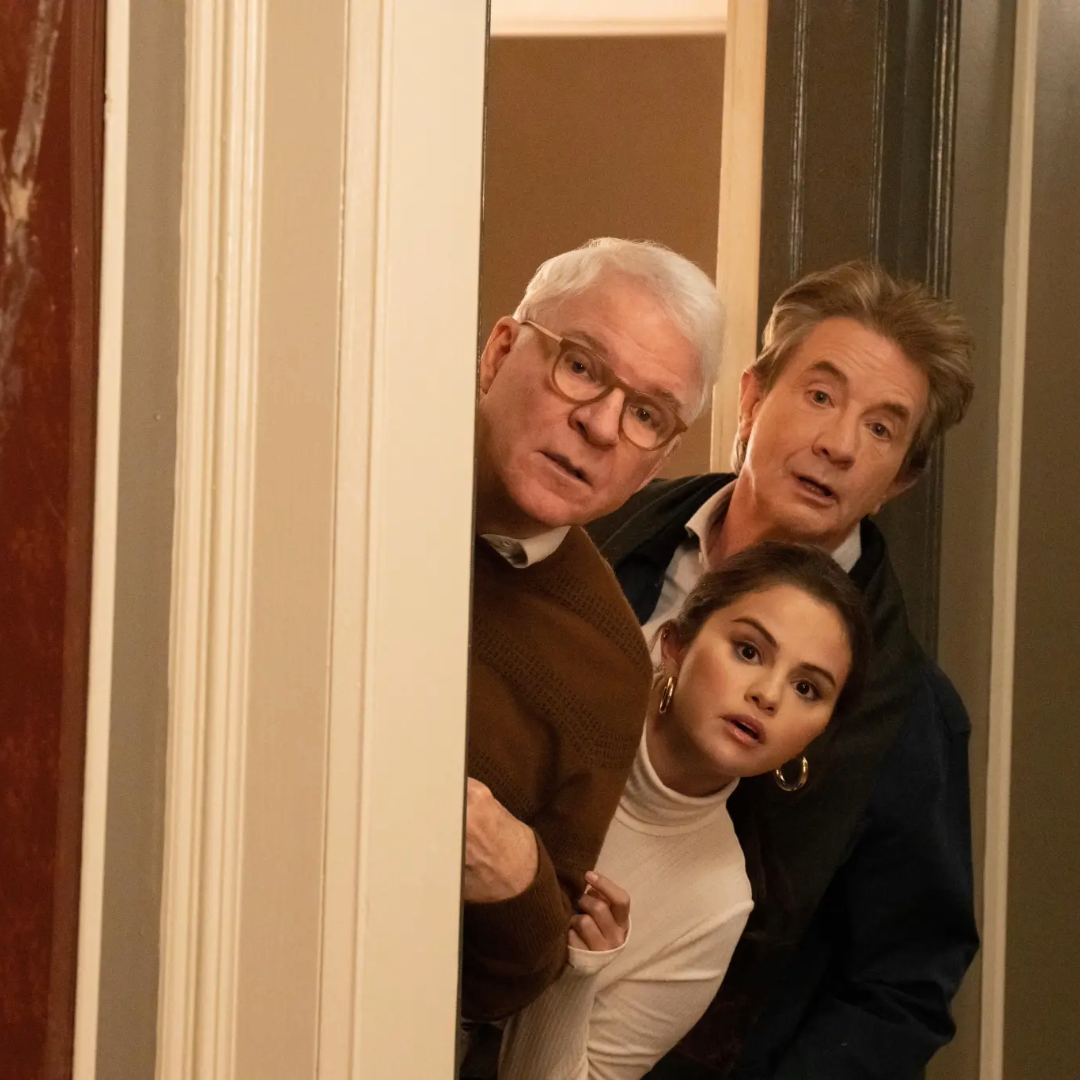
In the season finale of Only Murders in the Building Season 4, Selena Gomez’s character Mabel Mora (in one of the myriad mise-en-abyme moments of the series) finally decides that she wants to make a podcast that’s a “love letter” to Sazz Pataki (Jane Lynch), a beloved stunt-person-cum-writer who “tapped out” after… OK not too many spoilers here because we don’t want bad karma (we haven’t started Season 5 yet).
Bev Melon (Molly Shannon, because Jane Krakowski was clearly too busy [there’s no way that character wasn’t made for her]) is the Hollywood producer who wants to accelerate Mabel’s podcast career. Bev refers to an earlier conversation with Mabel, who, covering for herself, had said she’d podcast about a random object: Buttons. Counter to Mabel’s sweeping narrative of a passion project, Melon says: “But the algorithm really likes buttons.”
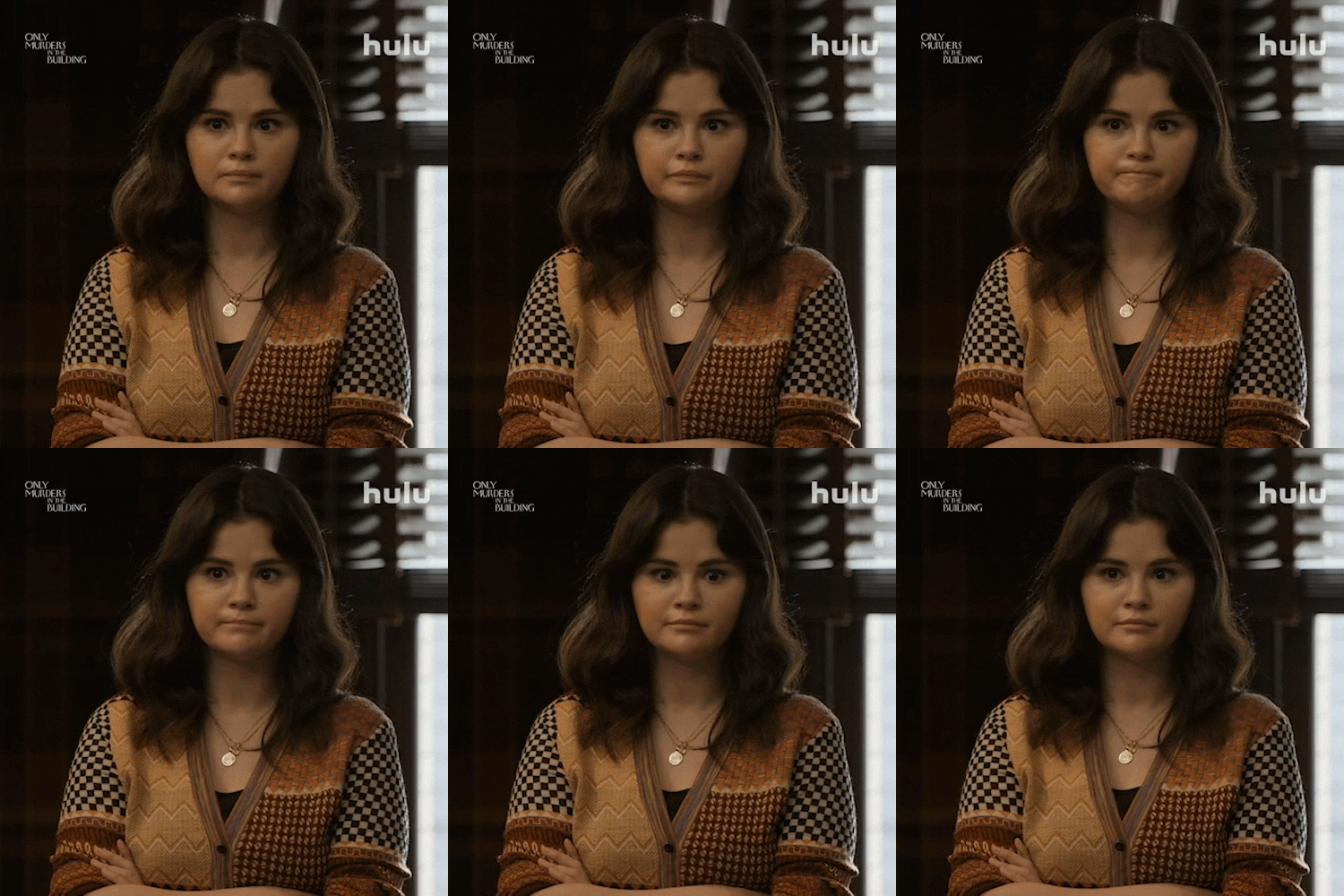
Buttons is an awful subject for Mora’s podcast. Even a cursory review would reveal that. But why is it so bad? It’s awful on two levels.
1. The output of this imaginary but semi-realistic algorithm lacks context that would steer it in a much better way. What do buttons have to do with Mabel’s knowledge and interests? There is no connection – it’s essentially a hallucination. This shows part of why human oversight is essential when decisions are at stake, and what can happen when an AI system is given a task beyond its capabilities.
2. “Buttons” in this TV script is a dig by writers at executives who think algorithms can replace writers (“All they’re doing is pressing buttons!”). To use an AI suggestion for the podcast’s theme feels off. Not all the requirements for a podcast theme can be easily articulated, but such difficult-to-measure requirements still exist and still need to be considered.
One requirement comes from that a podcast is a work of artistic expression. The “algorithm” lacks the context of being a human in the world and the subsequent need for aesthetic and meaning-making stories. There’s an awfulness about accepting the theme suggestion because there is a pretense of a closed subject as to what makes good art, when it’s an open subject — that, as a species, we are still discovering this for ourselves. If beauty is truth and truth beauty, use of the algorithm in the way the show pokes fun at would undermine a default to truth in artistic works.
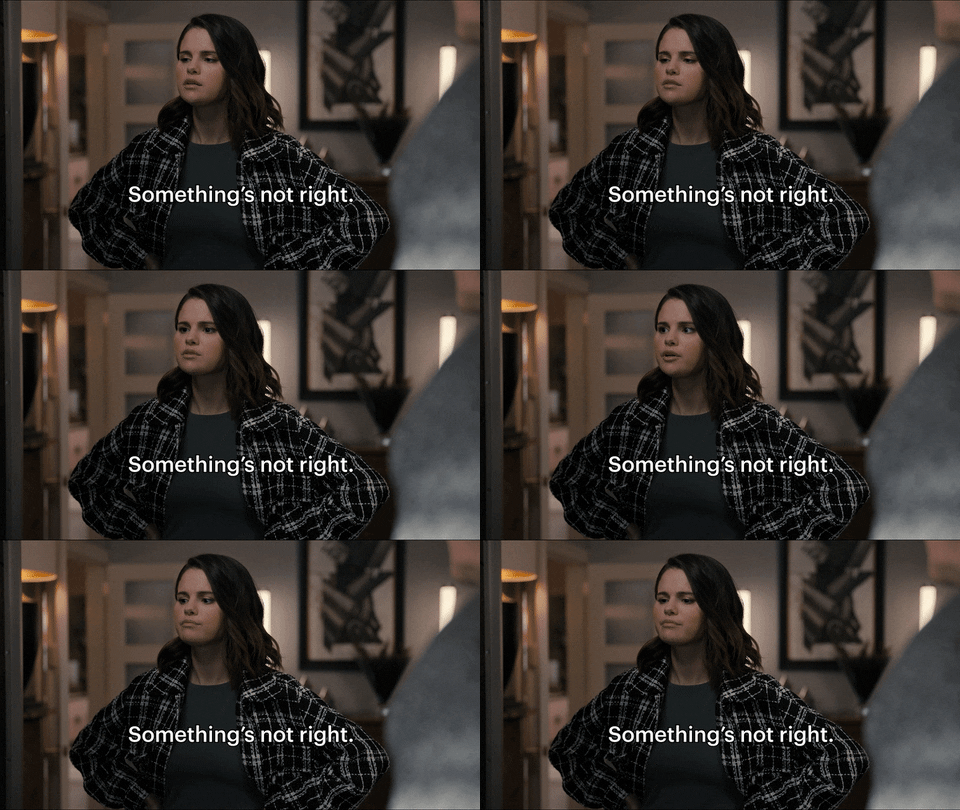
When working with AI, it’s helpful to think of it as an intern in its first week. In the capacity of scriptwriting, AI would be an intern in their first week with an uncanny unconsciousness of their work’s resonance with the human experience. Sometimes they spit out “brilliant” things, sometimes “awful,” but they have an uncanny inability to refine their tastes and steward the “truth” value of their expression of the human experience.
Gmail Autocomplete Competes to be Worse at Reasoning
Like the example above, this real-world Gmail autocomplete suggestion is also awful on two levels:

1. In the previous email, Person X has already offered me help, so responding that way would have been dismissive and rude. Without that context, the autocomplete might be a reasonable guess, but it requires some strong assumptions that turn out wrong in this case. So the AI is hallucinating what the email is about–annoying, but manageable.
2. But, the more interesting level of that response’s awfulness is that even when the context assumptions are correct, it still feels “off” for someone to accept this AI suggestion. Why?
That feeling of “off” is akin to the Uncanny Valley of robotics, but it’s a different kind of uncanny valley. Instead of focusing on aesthetics, it’s more about the intentions of the assistant. Autocomplete has become reliable enough that my previous guard against its suggestions has been lowered.
One aspect is that it feels insincere. If I knew someone offered to help, but it was because an AI suggested those words, I wouldn’t want to ask for that help. This case reflects a new challenge in maintaining trust in a world with powerful AI assistants. At a large scale, the default to truth in human digital communication is being undermined. So, then, how can one still convey sincerity and signal commitment in a world where much of any communication is by an artificial intelligence?
Like the podcast scriptwriting intern metaphor, maybe a refinement is required to work with this AI’s limitations. With email responses, something like an at times heartless intern or one with a surprisingly wide range of emotional intelligence (or quotient, EQ). This is part of what’s kind of “off.” A human wouldn’t respond with this wide an EQ. So maybe a good updated metaphor is to think of AI as an intern in their first week with an uncanny variability in EQ. That additional description, “with an uncanny variability in EQ,” encompasses both cases.
What are some lessons?
These examples get at two broader limits for AI workflow augmentation. One is that the lack of context means we have an increased responsibility to bring reality into the augmented workflow. We have much more context about the outside situation, so we need to be opinionated about what the situation needs, what the AI-suggested solution gets right, and where it falls short. Are there undefined requirements highlighted by the AI’s proposed response?
The other is that we have an increased responsibility to steward what makes life on this planet worthwhile and valuable. Poets struggle to define these perceptions we have, so algorithms trained on the words of those poets are an extra step removed from experiencing quality of life. This may mean we need to become more opinionated about what’s meaningful and worthwhile, even if we aren’t poets. We can’t always define what’s valuable, but we do sometimes know it when we see it. And we may need to refine our ability to see it, to understand the value represented in the Humanities in a world where humans are doing a decreasing proportion of production.
Regarding where oversight is needed for responsible AI use, these algorithms introduce something similar in spirit to what the EU AI Act would call Limited Risk. At least Melon admits that it’s the algorithm that drives her interest in Mora’s project. This at least allows for transparency and pushback, thereby reducing the risk of degrading the default to truth. This hints at where transparency is important — when it could degrade the public good of trust in communication in general.
So, should we start seeing disclosures in movie credits that the production is mired in AI use? Should we start seeing disclosures an email used AI tools?
By Daniel Garmat
Our founder has covered AI’s aesthetic uses before. Learn about artistic democratization here.
What happens when AI encroaches on human aesthetics? Learn more from Eddie here.
Always our ludic co-founder’s favorite blog tag: Fun with AI.
In this post, we used AI for polish, not Purpose.