Inside Malawi’s Virtual Science Classroom with Vision Thondoya
He was only one of less than a handful of Malawi’s featured delegation this July at AI for Good Summit in Geneva, but he’s a priceless developer no matter where you look. He’s one of the founders behind MiLab, a virtual laboratory tool that lets students run science experiments digitally when their schools can’t swing physical equipment, internet, or sometimes even electricity.
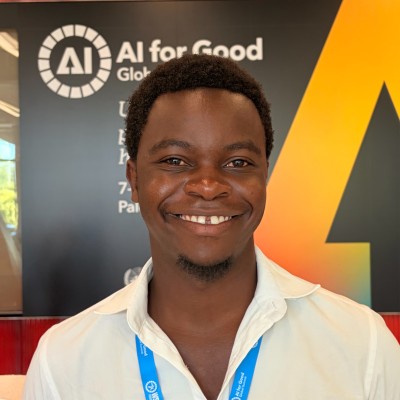
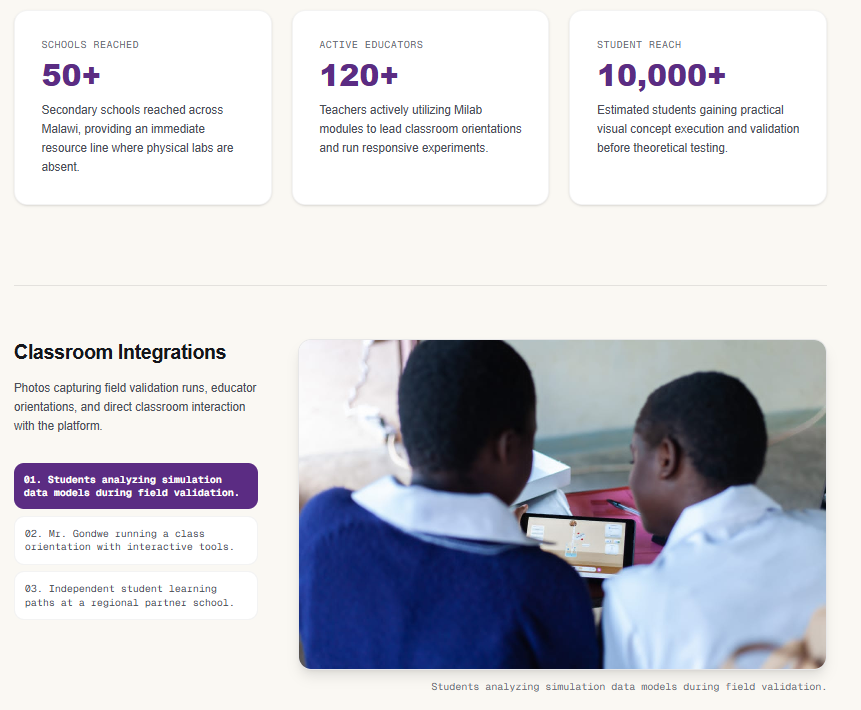
When it was founded, MiLab turned a pandemic-shuttered lab into a virtual one: physics, chemistry, and biology experiments students run on a basic phone or tablet. Thondoya’s app won Malawi’s national ICT award this spring, in case you want a *litmus test* for whether virtual can replace physical. He ran a few demos with us and I loved the part where we didn’t get scalded by a Bunsen burner.
We first met at the tail end of the conference, when my own curiosity got the best of me (remember those “African country” projects we did in K-12? I’d done Malawi.) But we reconnected online after the conference when my curiosity about his product carried on, and I hope I will continue to see how MiLab grows.
Caroline: Talk to me about what changed once you were able to exhibit at AI for Good.
Vision: Along with media coverage, for the most part we are working on a few partnerships with our base users — that’s people actually in schools that use MiLab. We’ve had a lot of interest from teachers, we’ve had a lot of interest from students that at first did not know that we have MiLab, and that some of the problems that they are facing in the schools can be fixed by what we’ve done.
Caroline: Did you start MiLab around the time of the COVID shutdown?
Vision: That’s right. Really, the [painpoint] was that students had a lot of time back at home, including myself… but what made it especially difficult in my country is that already a lot of students were already coming from under-resourced schools — schools that don’t have laboratories, schools that don’t have enough teachers — and [COVID] made the problem worse. So really the philosophy was: We have an infrastructural problem, in our case the lack of laboratories and even school teachers. If we can introduce a digital technology that addresses that while keeping the cost of expansion and scale very low for schools and government, then that would really be something that will be a win-win for everybody… Now we’re in no way trying to replace traditional laboratories, but the idea is… we still want to expand quality education in the absence of those things when they are not there. So what’s the next best thing? We give them virtual experiences that closely match the realities of practical science.
Caroline: What are some things that this virtual experiment can do that a real one can’t?
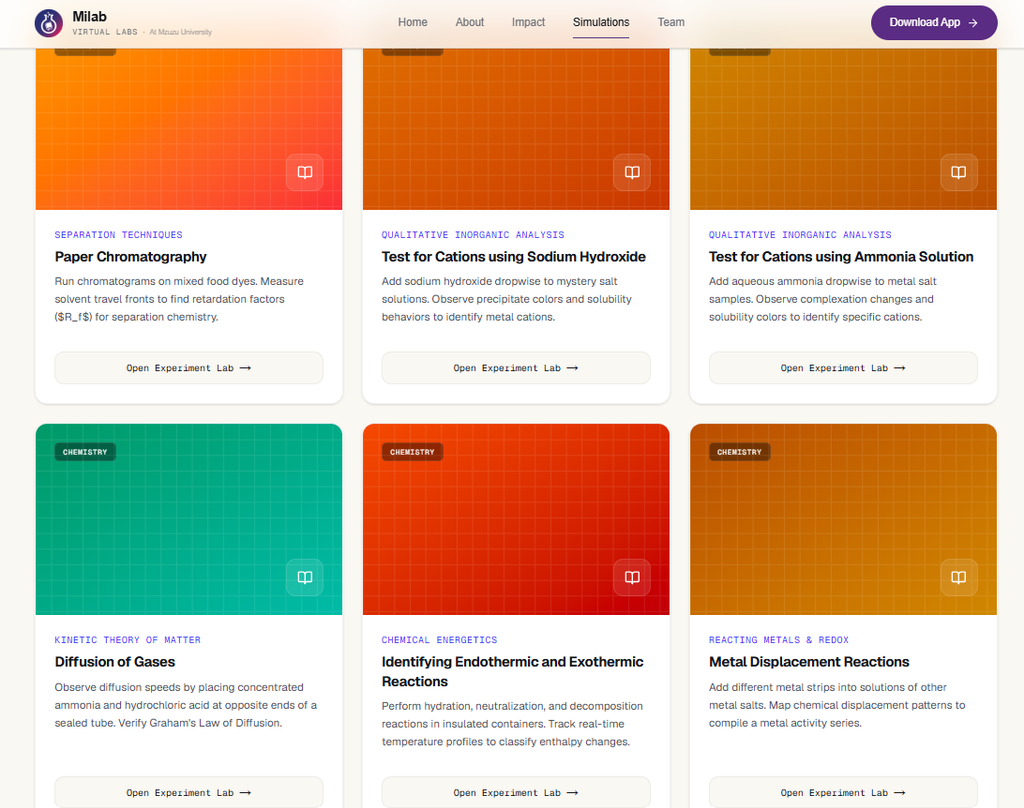
Vision: Students learn through imagination, they learn through emulation. Can we take simple things that they know — those simple ideas that they might already be familiar with — and then build from that to give them the most high-quality science education possible? So I’ll give you an example. Consider the pendulum experiment, where students have to measure how long a pendulum takes to do a full swing. Instead of just performing that experiment as it would be on Earth with a set acceleration due to gravity, we say: okay, what if the gravity was different? What if the gravity was the same gravity that is on Mars, or the same gravity that is on Jupiter? Then how would the pendulum actually behave? In a lab you’d need special equipment to be able to emulate what would happen if you were on Jupiter. But with software, it’s just a few lines of code, and if these schools can’t even afford a beaker, then they can definitely not afford any of [the special lab equipment].
Another thing is some experiments are too hazardous to perform in a real-life laboratory, even if you do have equipment. So one of the experiments that we have is on the effect of different kinds of radiation and what kind of material they can penetrate. Students are basically playing around with that. We might not want students near any kind of radiation… but with MiLab we can.
Caroline: What were some parts of the early version of MiLab that didn’t work, that you had to scrap?
Vision: The first thing that I’m happy that we realized early on was the issue of the internet. [The first] version of MiLab required internet connectivity, but the obvious thing was like, okay, this cannot work in resource-constrained situations, which is 70% of the schools in Malawi. The second thing was the first version that we built was 3D, because we wanted it to really feel like a POV [game]. But then we quickly run into the problems of hardware, because if you think about the typical student in Malawi and in the greater part of Southern Africa — in fact the Global South — you don’t expect them to have devices that can handle graphic-intensive applications. So we also had to learn from that and see how we can adapt [with 2D].
There was some initial pushback, I think, from some of the teachers, and the reason was: most educators, when they hear about an app where a student can perform experiments, they think, “Well, where’s my part in that?… Is this [tool] coming in to replace me?” So it took a little bit of sensitization to let people know that what we’re doing is not a replacement for teachers and laboratories. No, the students still need that. But what we want to create is a blended learning experience where the teacher is complemented by the experiences that the students can get in MiLab.
I think it’s an issue that anybody that’s trying to build technology, especially with AI now, is going to face because people are worried about their jobs; people are worried about what technology is [coming] for them and their livelihoods. It might be the most mind-blowing AI that you’ve ever built, but if it threatens people’s livelihoods, it can be difficult to navigate.
Caroline: I will speak from the perspective of being a teacher. A lot of those around me were teaching for over 20 years, and I think that their issue with the new technologies was that they were just a new thing that they had to learn [to add to their plates]. And, to me, that’s not threatening. You’re simply in the same position as the students. The students have to learn a lot of new things. So [teachers] need to adapt too.
In terms of the modules that you have for MiLab, what is your favorite, or your proudest, that you developed?
Vision: Pretty funny story for that one: In the earliest days, when we had just developed our prototype, we worked together with the government and some development partners like UNDP to bring some teachers together, so that they see if [MiLab’s prototype] fit their needs. As a software developer, I went up there proud and boastful of my Frankenstein of a creation. And I remember there was one particular teacher who was not impressed at all. And he did not mince his words: “You know what, guys? Let me just tell you the truth. Nobody’s going to use this… and the reason is that you’re not tackling so and so and so and so.” So he walked us through some of [what] teachers go through as they’re teaching some of these scientific concepts in class, and basically his point was: you need to move away from conceptual teaching to more practical teaching, because that’s what’s missing. A child might memorize a concept, but they might not have the practical experience of that particular concept. And basically what we want them to do is to learn by doing, and not just by memorizing.
So we divided the teachers after that into work groups, and each group was responsible for coming up with the most critical challenges that they face in the classroom. One recurring experiment was an experiment on acid-base titration. A lot of equipment involved in that one… so pretty tough. It was good that most of them identified it, but it was pretty tough to work through because of all the math involved, and then all the various things that could go wrong. That was the toughest, but it was also the most satisfying, because to date, it remains one of our most popular modules.
Caroline: I think that what could make that memorable is how hard it is to get just right before you see success. So how are you assessing a student who ran the lab, and how they actually learned, as opposed to just clicking through the steps? Do you have any before-and-after assessment data?
Vision: Oh yes, 100%. We once performed a study centered around how ideal it is to use MiLab, whether it’s before the student is introduced to the actual physical experiment, or after they have already been introduced to that experiment. What we found was that there was very little difference in the performance of the student when they were introduced to the experiment through MiLab and when they were introduced to the experiment through the actual physical lab. And that was a very good finding for us because it’s always a concern, isn’t it, when you have education technology, to say: to what degree is it where the student is just excited with the technology, and to what degree are they actually learning? One thing that we haven’t done but would like to do is to evaluate for development impact — because apart from just the learning happening, we also need to assess whether these students have gained the practical skills that they need to actually solve challenges in their local communities.
Caroline: If you had unlimited funding tomorrow, what is the first change that you think you would make?
Vision: Obviously we would want to help build as many laboratories around as we could. But assuming that was one thing that we couldn’t do — because you know, once we do that, then no need for us, right? — assuming that, it would be about creating more sustainable systems for being able to take students from ground zero up to a level where they’re able to solve their own community problems. We’re not just trying to teach students science. What we want is to give them the problem-solving skills that they need to be in a position where they can solve their own community challenges, just like we have. They have to be able to identify problems in their community in relation to the sustainable development goals that they have — whether it’s in food security or in energy. As we speak right now, we don’t have power. I’ve been trying to turn on the lights. But then what if we could give these kids the ability to solve this challenge that they see every day? So the thing that we would do is to make MiLab a holistic platform, where we take [students] from to a place where they’re able to design solutions for themselves, through consistent innovation, through consistent building and industrialization. And that’s one thing that we lack in my country, as well as in southern Africa, but it’s not because these kids are not bright enough. It’s just because they don’t have the opportunity to be able to understand what it takes to build for their own communities.
Edited for clarity. In this post, we used AI for polish, not purpose.
Interested in AI that serves nonprofit missions? Read our monthly update for spotlights on funding, tools, and people building responsibly.
Know who else are leading pushback against AI as a replacer? “Should You Trust an AI Doctor? Why Chatbots Still Need Humans”
Know who else sat down with me to chat about AI workflows for good? “Train Your AI First: A Conversation with Dr. Lu”
Leave a Reply