Summing up global AI data that does its best not to set an agenda
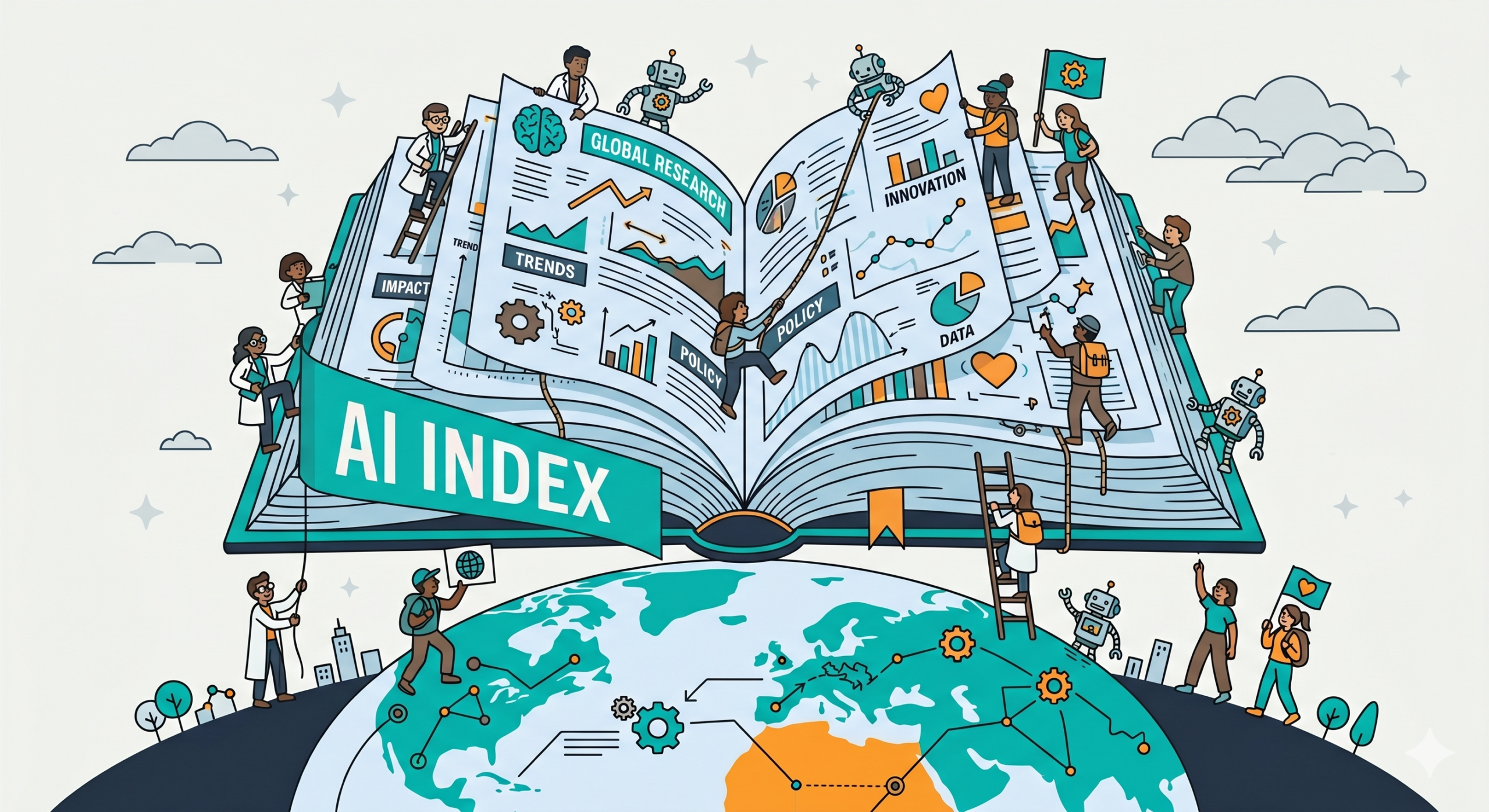
Recently, I had the opportunity to listen to some experts at Stanford’s Center for Human-Centered AI cast the widest net possible on current (OK last year’s) research on AI. It’s basically a global literature review that captures one year of data from academia, Pew-like institutes, think tanks, data-driven journalists, open source frameworks, worldwide governmental reports, and whatever escapes the enterprise black box. It’s all neatly summed up (in 400+ pages) in the AI Index Report. The goal is data-driven discourse without recommendations, not agenda-setting for media, politics, and enterprise. Just trend-surfacing and benchmark-emergence allowed here, folks. And they’re as replete as possible. Caveat: there isn’t always clarity on the denominator for what I report here. Methodologies and stratification were accounted for in 425 pages, I’m sure, but miss me on reading the whole damn thing instead of reporting from the webinar and panel!
So, what surfaced/emerged?
First, which felt pretty obvious for someone working in the AI field, is that AI is scaling faster than the infrastructure can absorb. How fast? There have been over 2,000 AI companies incorporated in the last year (nb: AlignIQ doesn’t count as we’re categorized as a consultancy). The TSMC foundry in Taiwan is *the* place to get the AI chip that most AI developers use–it’s not so much a monopoly as much it shows a supply chain in its infancy.
88% of organizations are deploying AI, 53% of people are using at the population level, and global corporations are investing at two times the rate of last year. (All that money we were investing in people had to go somewhere, right?) US leads investment, at 23 times as much as China (!) Data centers, warehouses, and cloud space, not just broadband is how these tools get used–that amount of space hasn’t kept up, so let me share my first opinion*… thank God for that. Still, the US has the lion’s share of data centers, with 10 times as many as any other country. I was still quite surprised to see their increasing volume in OECD countries.
Now, the performance of AI? We’re still at the point that same natural language systems perform unpredictably… ask a chatbot to do a task today: success! Do the identical one tomorrow: failure! But agents are improving tremendously fast on real computer tasks (12 to 66%). 70% is the “human pass rate” for tasks (according to whom, I don’t know, maybe Stanford). Getting close! How ‘bout those physical robots, the harbingers of AI, which have been around for over a century? Only 12%. Too bad; I’d much rather have AI clean my house than organize my schedule.
Indeed, public sentiment (as we talked about in flaming cheeto post) is lowest in the US among all countries that measured it. SE Asia and China have the most positive feelings towards AI; the Global North trends more towards distrust, which we’ve blogged about recently. This mirrors other research on how individuals feel towards institutions in these regions, so nothing mind-bending there.
The top 10 frontier models–OpenAI, Anthropic, DeepSeek, Gemini, etc.–are rated by the public within a 25 point range of one another, whereas the range in last year’s report was 97. China’s overall AI performance narrowed sharply with the US despite major private investment differentials.** Given that their strongest products are based on the back end of the US’s greatest, there’s expected to be some gap, perhaps in perpetuity. But let’s be real. A real solid chunk of the talent that’s in the US is brain draining.
Speaking of brains, it comes as no surprise to me as a former middle school teacher that US education’s response to AI has been nothing short of neglectful. 84% of students have said they use AI just for classroom assignments. The amount of AI policies being established in a country whose educational centrality is disintegrating more and more every day are less than 10%. This is worse than nonprofit policy adoption. I smell a pivot…
Economic and workforce indicators seem to get the lion’s share of reporting on AI. 1 in 3 organizations expect reductions in force in the next few years, but most especially in marketing, sales, and software engineering. Jobs for entry level workers are fizzling out as productivity increases via AI.
The most worrisome takeaway, in terms of how institutions compile this valuable data, is that benchmarking is impossible to keep static. My understanding is that new performance indicators are needed for AI’s eventualities. Saturation for some benchmarks have emerged, meaning that goalposts actually need moving. If you run out of benchmarks, you can’t really say that humans are controlling the AI narrative, let alone the AI tools themselves. We might get Dan to short-form the details of this soon.
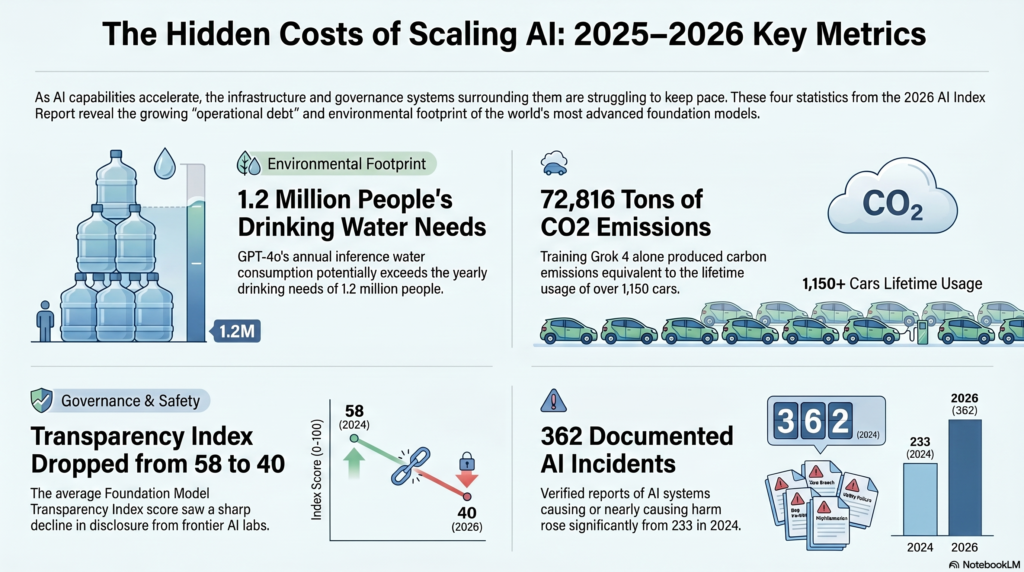
Even more worrisome, but for society as a whole, is that the transparency these frontier orgs are offering is worsening–58 to 40% according to the Foundation Model Transparency Index. As oversight lags, major incidents are piling up in the hundreds, which, of course, proportionally to all the helpful and benign incidents of daily use, is a drop in the bucket. Then again, “major incidents” wasn’t clearly defined. If I’m being honest, I’m surprised more violence isn’t being attributed to the instructions of chatbots. Like I said, benchmarks! We have clear accountability systems in place to track gun violence in schools, drunk driving, and legislators’ dumb choices that lead to “major incidents.” We need the same for AI.
That about covers my major learning from the webinar, but I was curious to dig a little deeper on what’s relevant for AlignIQ’s milieu: social impact. We’ve done a rundown for 2026. So what else we got, school with a tree for a mascot?
Just as infrastructure isn’t being deployed as quickly as the products, responsible AI is not keeping pace. Given spotty reporting on safety benchmarks and a rise in “major” documented AI incidents from 233 in 2024 to 362, the takeaway is that adoption without governance is, ultimately, operational debt.
The “AI divide” is in not only access, but also institutional readiness. The reporting that generative AI reached 53% population adoption in three years doesn’t tell much of a story in my eyes. Adoption and usage varies by country, correlating with GDP per capita. Maybe someone used AI once last year, and they get counted among the adoptees who can’t get enough of the people-pleasing processor. Indeed, folks may have access to tools, but not equal access to policies, training, evaluation practices, language support, procurement knowledge, or safe implementation pathways.
Workforce development is a social impact issue in disguise. The report highlights productivity gains of 14% to 26% in customer support and software development, but also notes weaker or negative effects in judgment-heavy work, and flags that entry-level employment is declining in some of the same fields where AI productivity gains are clearest. This is highly relevant for workforce boards, youth programs, adult learning, career services, and nonprofit employers. See also: Wanted: Nonprofit Staff Who Can Wrangle AI and Still Care About People. So, are we using AI to build human capacity, or to remove the bottom rung of the ladder?
Trust is fragmented, and nonprofits may be better positioned than governments or companies to mediate it. The report expresses a lot about folks’ attitudes towards AI, and experts and the public are far apart: 73% of experts expect AI to positively affect how people do their jobs, compared with 23% of the public. It also notes fragmented trust in institutions to manage AI, with the U.S. reporting the lowest trust in its own government to regulate AI among surveyed countries (Gee, I wonder why!). How might this be good for the AlignIQ likeminded? Well, social impact orgs can use this as a case for community-centered AI literacy, not just tool evangelism.
AI sovereignty has a “local control” version that matters for communities. The report’s sovereignty section is not just geopolitics. It connects sovereignty to who controls AI infrastructure, procurement, policy, public-sector deployments, and digital public infrastructure. It also notes that open-source development is spreading participation beyond the U.S. and Europe, supporting more linguistically diverse models and benchmarks.
The environmental footprint earned its spot in the social impact conversation. The report estimates Grok 4 training emissions at 72,816 tons of CO₂ equivalent, AI data center power capacity at 29.6 GW, and annual GPT-4o inference water use potentially exceeding the drinking water needs of 1.2 million people. This is super relevant for climate nonprofits, environmental justice groups, grantmakers, and any org trying to reconcile tech adoption with sustainability values.
As Dan and I phase out of teaching our course on ethical AI for nonprofit practitioners, we have a lot of numbers to help back us up in our next cohort of anxious learners. What more should we be teaching to keep AI safe, sustainable, and usable?
Want to learn more? Here’s Stanford’s report.
*Other than the antecedent parenthesized snideness, I guess.
**Taxpayer supported development in every country other than the United States is relatively stronger, to be sure. How much? The moderator revealed that globally, other public and academic investments are harder to track for the proportion of money that passes through. Thus…accounting for investments from US’s private sector is more transparent. Who knew?
[In this post, we used AI for polish, not purpose.]